
The following is a summary of global temperature conditions in Berkeley Earth’s analysis of May 2026.
- May 2026 was nominally the 2nd warmest May on record behind 2024 and slightly ahead of 2025. The global average was 1.35 ± 0.11 °C (2.44 ± 0.20 °F) above the 1850-1900 average.
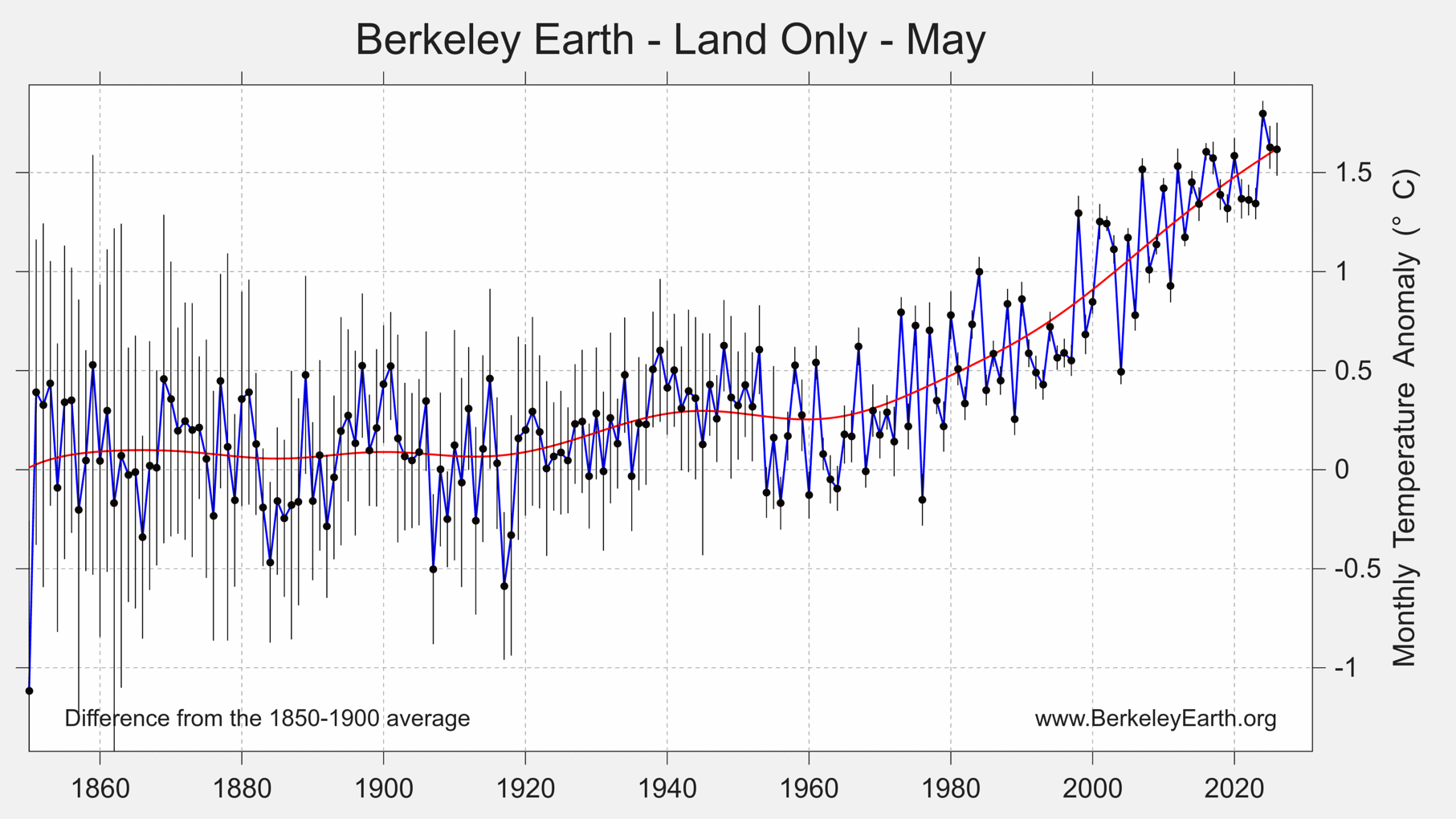
- Land temperatures averaged 1.62 ± 0.21 °C (2.91 ± 0.37 °F) above the 1850-1900 average, ranking as nominally the 3rd warmest May for terrestrial regions though similar to several other recent years.
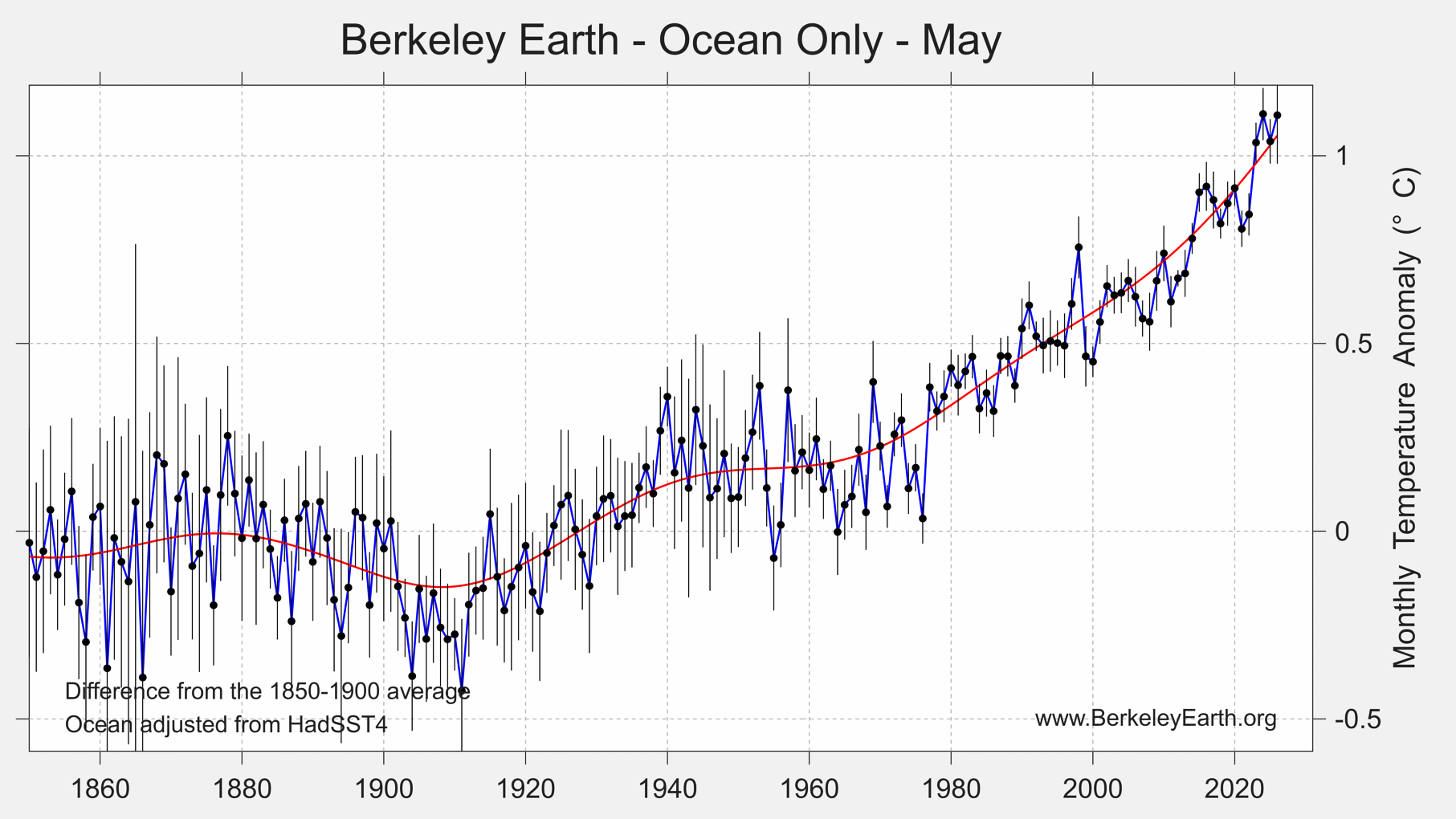
- Ocean temperatures were 1.11 ± 0.13 °C (1.99 ± 0.24 °F) above the 1850-1900 average, making it nominally the 2nd warmest May for ocean surfaces, though effectively tied for first.
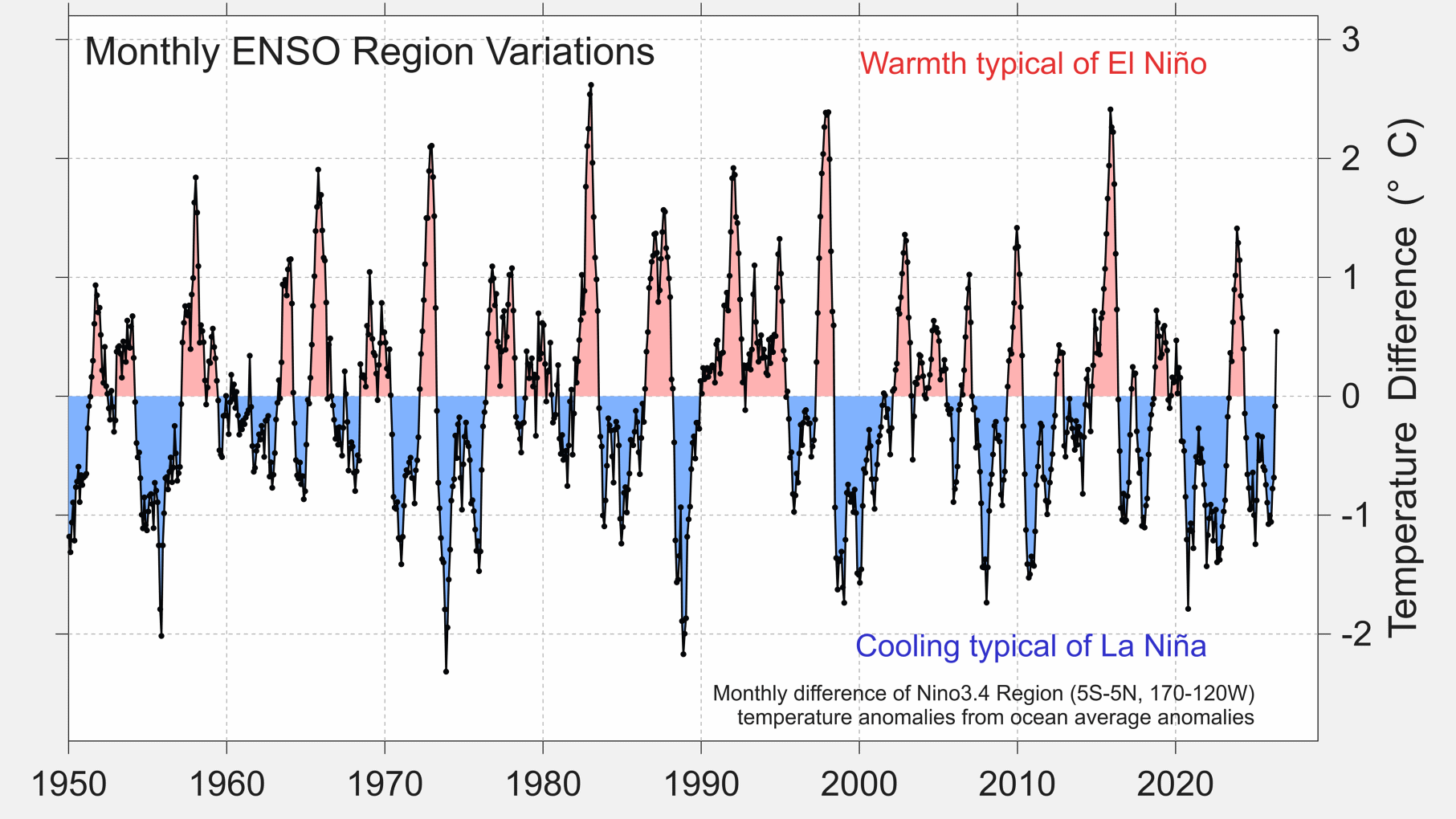
- May temperatures were particularly warm in many ocean basins, especially the Pacific, where a new El Niño has begun.
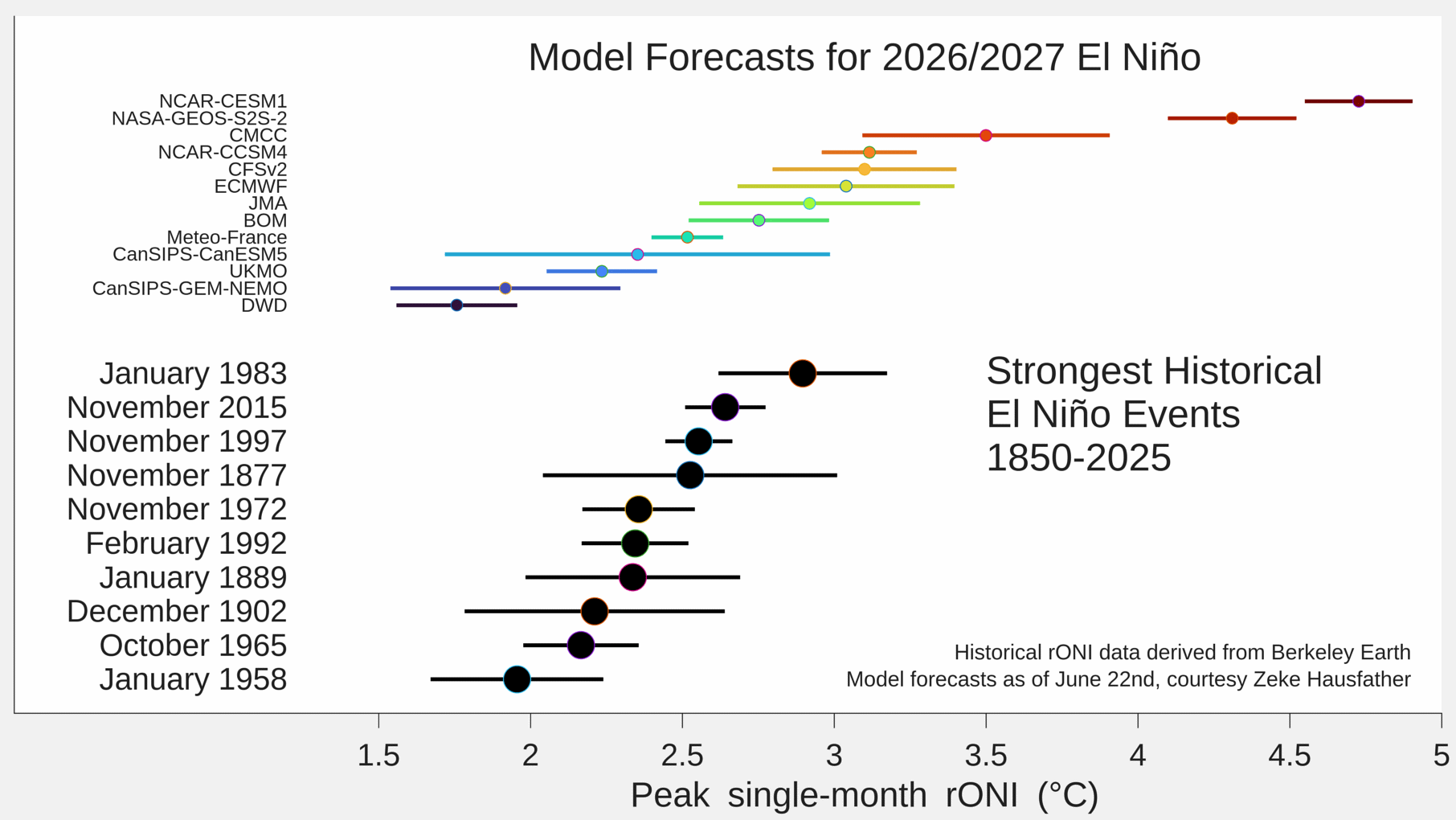
- The current El Niño is expected to strengthen rapidly. Many forecasts now expect a very strong El Niño to develop by late 2026, with forecasts including a significant chance of developing the strongest El Niño since 1850.
- 4.1% of Earth’s surface experienced a record high May monthly average, including 5.8% of ocean areas.
- 2026 now has a 2.5% likelihood to be the warmest year on record.
Global Summary
May 2026 was nominally the 2nd warmest May on record, behind May 2024, with a monthly global average of 1.35 ± 0.11 °C (2.44 ± 0.20 °F) above the 1850-1900 average. May 2026 only marginally exceeded the conditions in May 2025, but exceeded all other previous years by a clear margin.
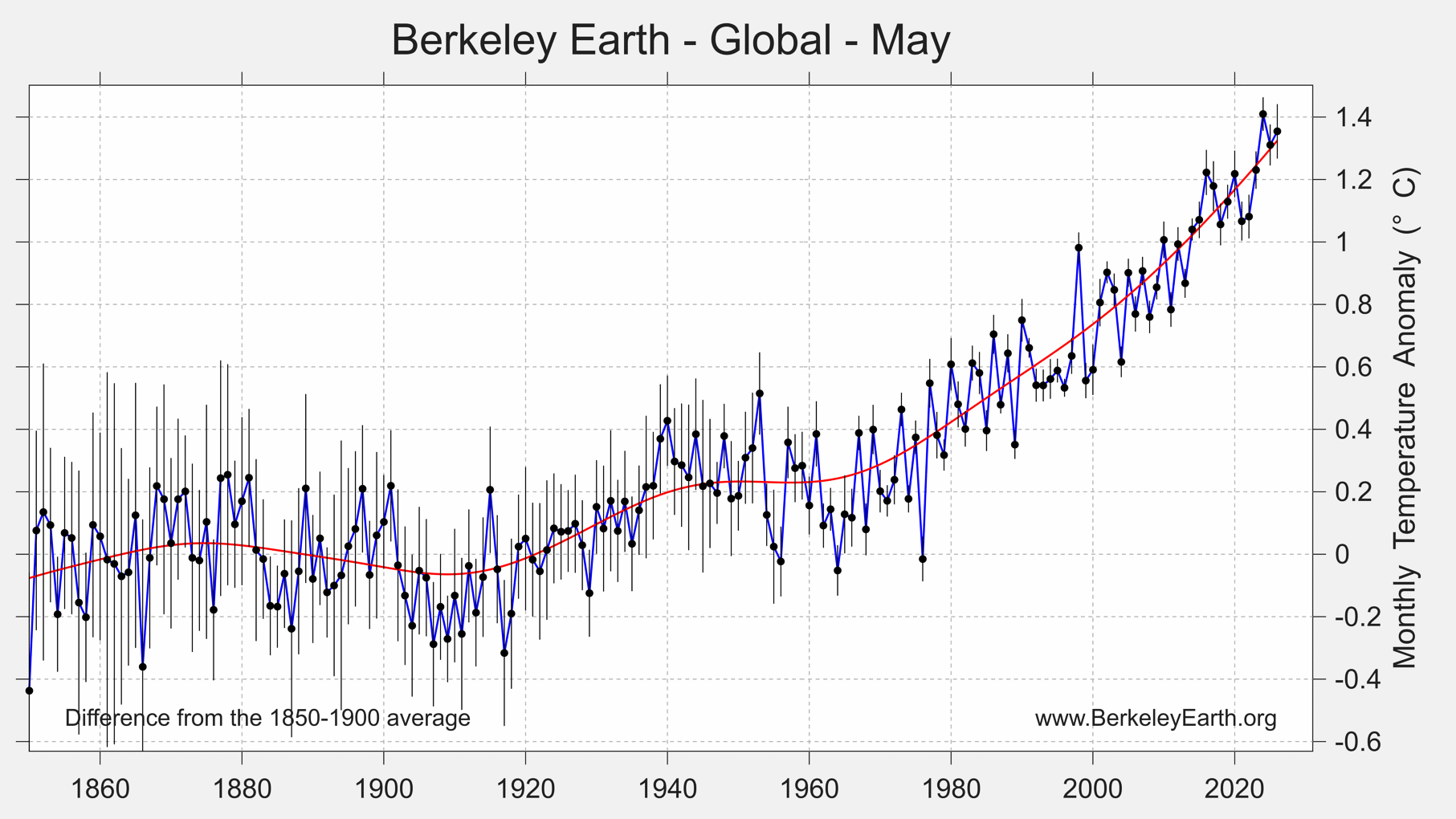
Month-to-month temperatures declined modestly in May 2026 relative to April, reaching a level similar to January 2026. Current conditions are modestly below the long-term trend line, and well below the recent record highs from 2023 to 2025.

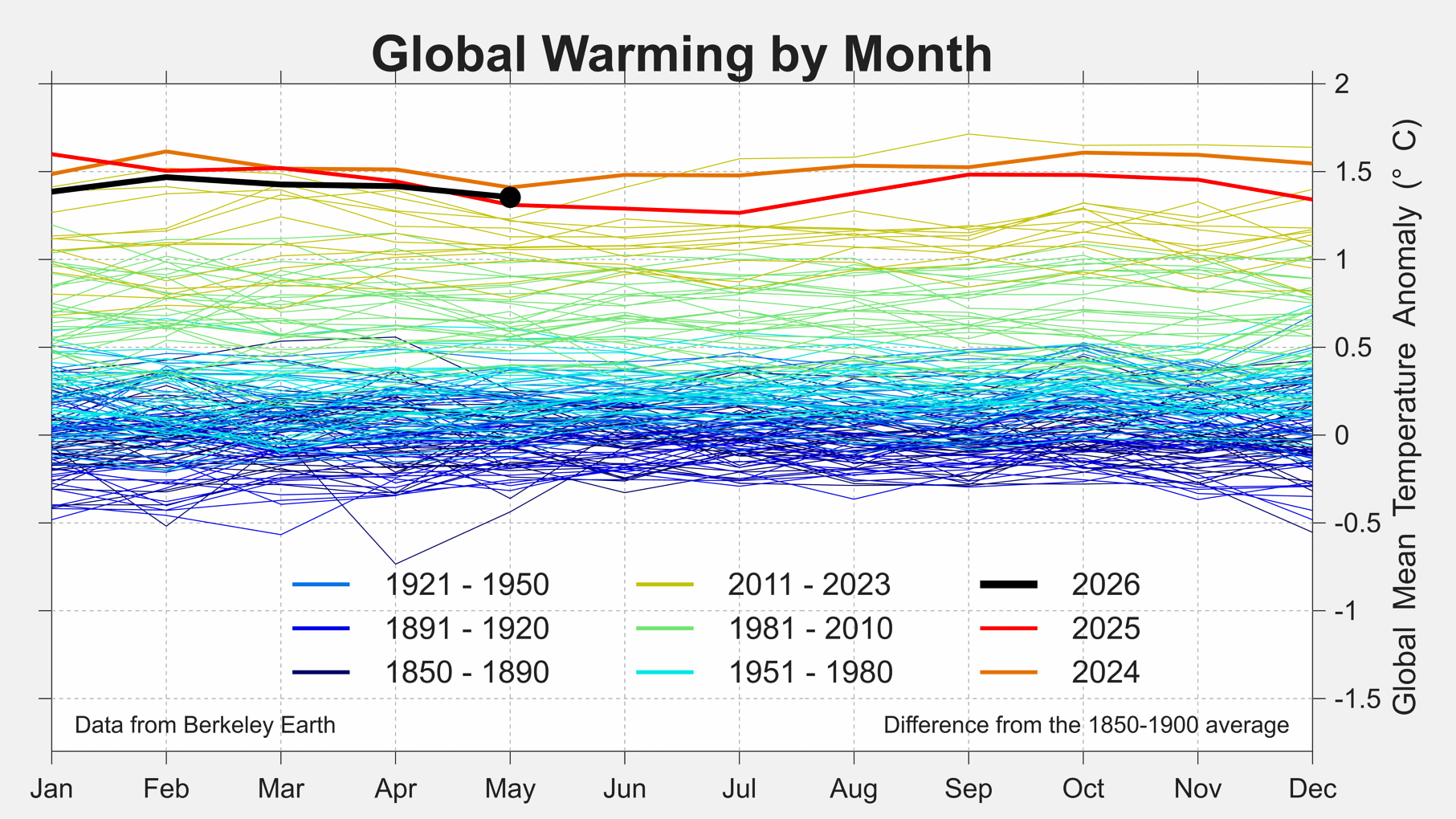
Thus far, no month of 2026 has been record warm, with months often ranking 3rd or 4th overall. This still places 2026 among the warmest years ever measured, but noticeably behind what would be needed to achieve a new record pace.
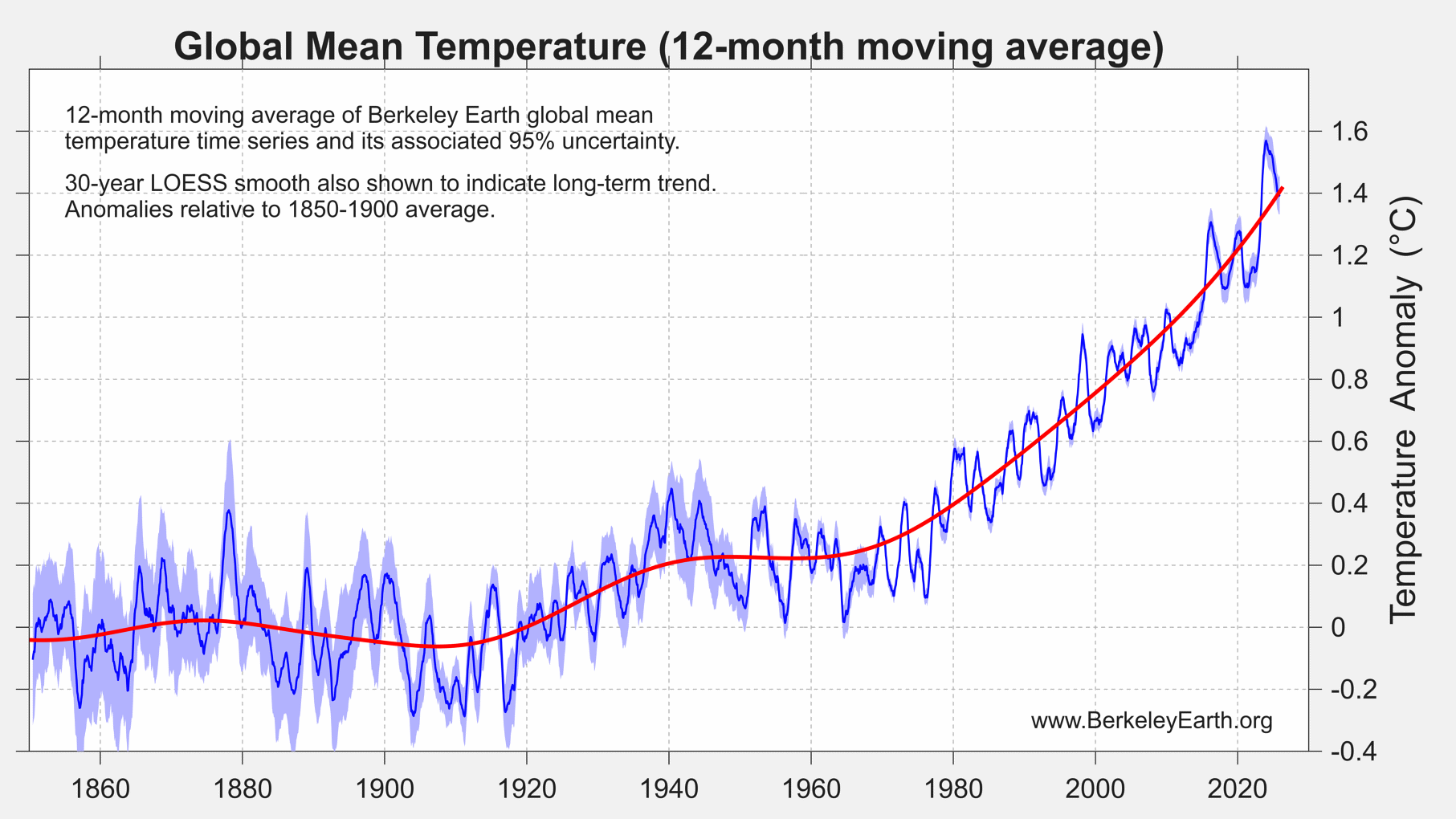
The 12-month moving average is now near the long term trend line. The short-term natural variability contributing to anomalous warmth in 2023 & 2024 has dissipated. Based on historical patterns, we would usually see temperatures now temporarily dip below the long-term trend. However, the return of El Nino makes that unlikely in the present case. Short-term variability is an inherent part of the weather and climate system, and it is to be expected even alongside persistent long-term global warming.
Spatial Variation
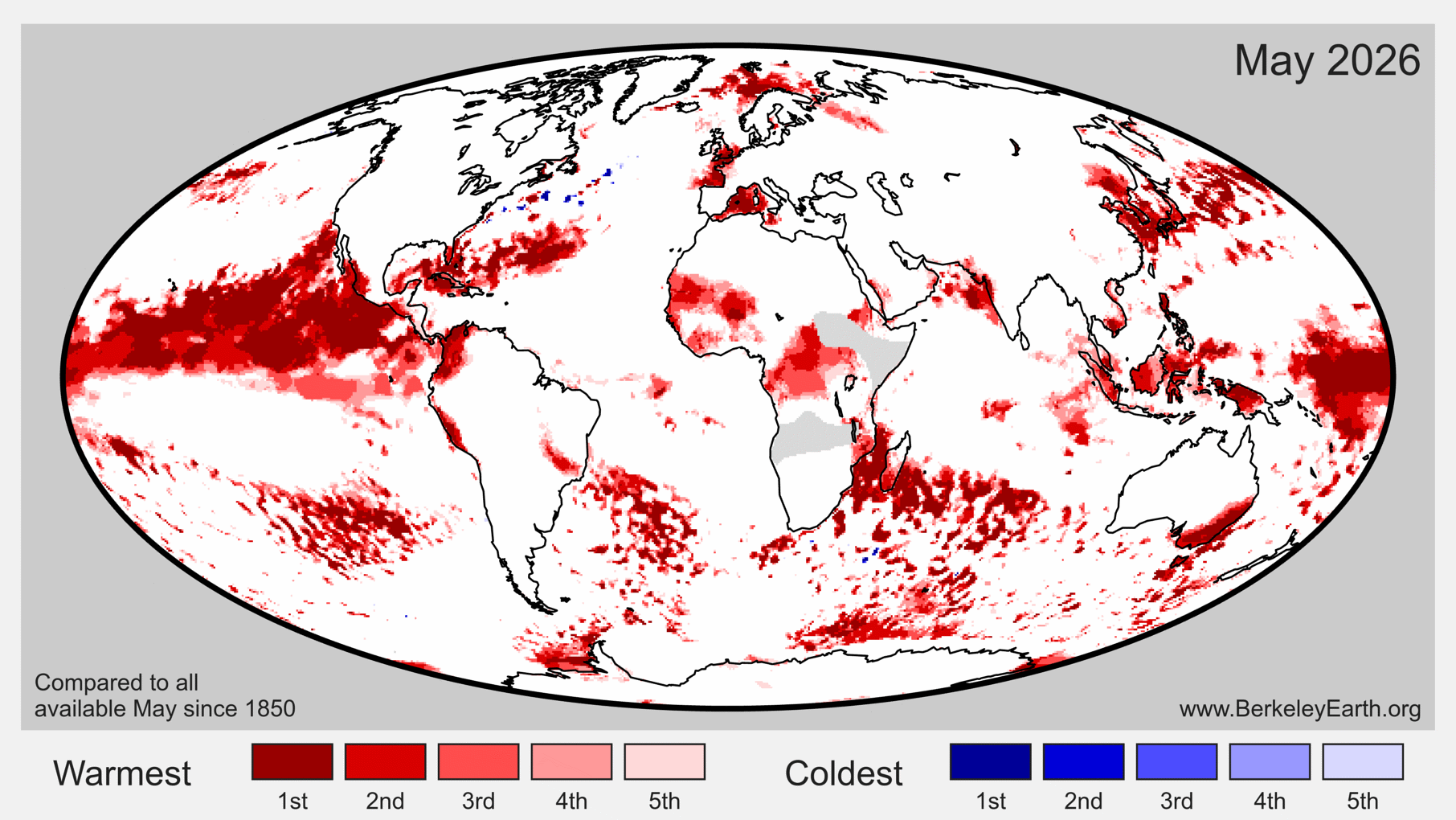
In May 2026, elevated temperatures were present in most regions. These were especially prominent across Western Europe, Northwest Asia, parts of Antarctica, and multiple ocean basins, including parts of both the Pacific and Atlantic. Cooler temperatures were present in parts of South America and the Middle East.
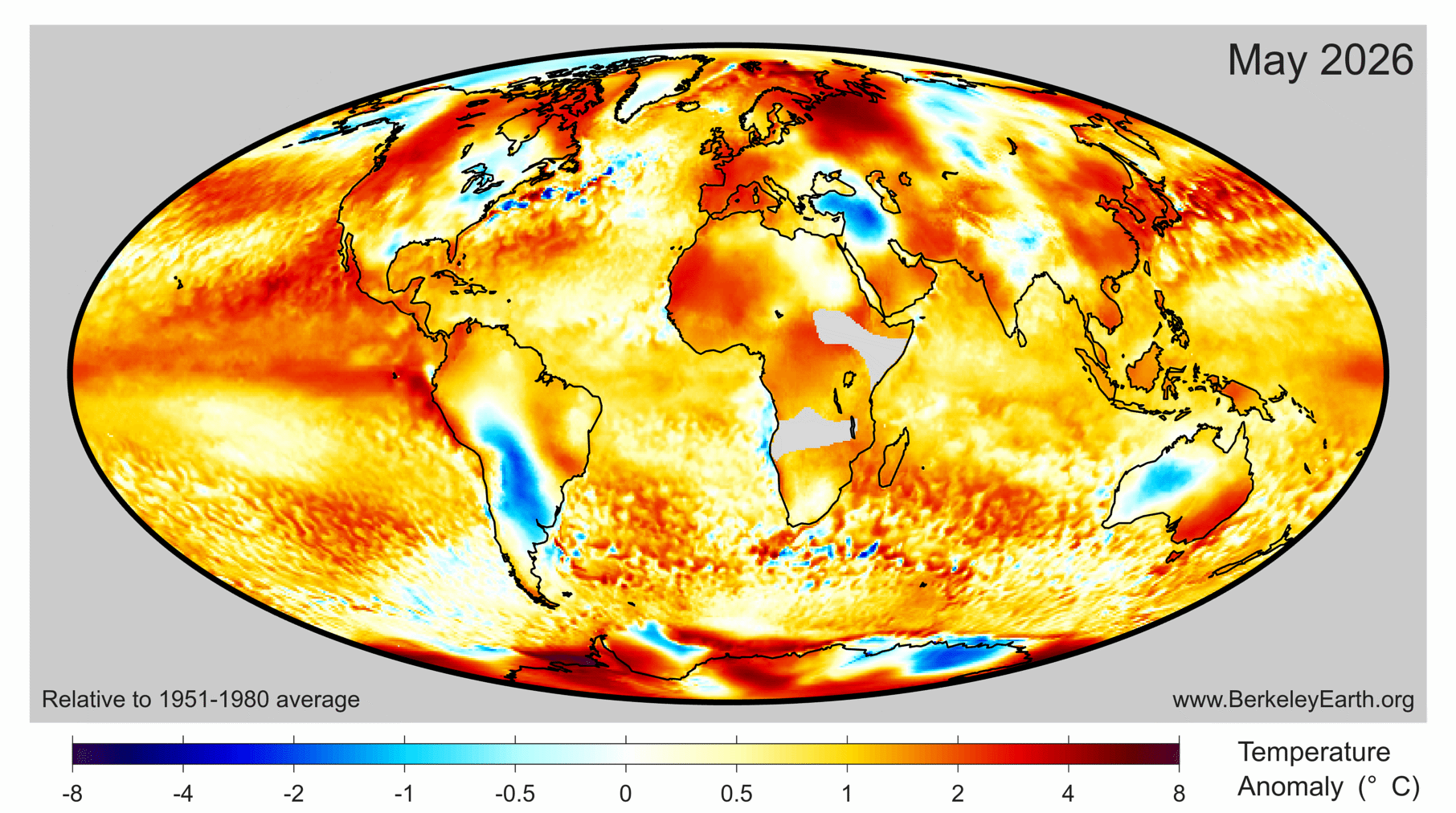
4.1 % of Earth’s surface experienced a record high May monthly average (0.8% of land and 5.8% of ocean surfaces), with record warmth especially prominent in parts of the tropical Pacific Ocean. It is unusual that the percentage of land setting a record and the percentage of ocean setting a record are so different. In part, this is likely an indication that the building El Niño in the Pacific has not yet translated into similar warmth over land.
In Berkeley Earth’s estimation, 8 countries set record warm national averages in May, including: Cabo Verde, El Salvador, Japan, Malawi, North Korea, Singapore, South Korea, and Zambia.
Over land regions, May 2026 was nominally the 3rd warmest May since 1850, with a terrestrial average of 1.62 ± 0.21 °C (2.91 ± 0.37 °F) above the 1850 to 1900 average. This is clearly cooler than the record in May 2024, but May 2026 was similar to May in 2025, 2020, 2017, and 2016, and these five years are all effectively tied
On a month-to-month basis, May 2026 is modestly cooler than April 2026, but similar to months in mid 2025. The monthly average on land is noticeably below the long-term trend line. This will be expected to rebound higher once the impacts of El Niño become more pronounced.

Average ocean temperatures in May 2026 were equal to 1.11 ± 0.13 °C (1.99 ± 0.24 °F) above the 1850 to 1900 average. This was nominally the 2nd warmest May on record (behind 2024), but given the uncertainties 2024 and 2026 are effectively tied for first.
On a month-to-month basis the ocean average declined slightly in May compared to April though with large uncertainties due to the preliminary nature of the May data. Except for May, the last several months have seen ocean average temperatures increasing as El Niño develops, though it has not yet reached the highs of the last El Niño. Ocean average temperatures are expected to continue building as the El Niño strengthens.

ENSO Conditions
The equatorial Pacific had a La Niña in early 2025, transitioned back to neutral conditions in mid-2025 before dipping back into a La Niña state in late 2025. That second La Niña persisted into the start of 2026, but has now ended.
The scale is now tipping sharply in the other direction. Rising temperatures in the equatorial Pacific mark the return of El Niño. As of May 2026, that El Niño is weak, but it is expected to build rapidly over the coming months into potentially one of the strongest El Niño events in modern history.
As of the most recent IRI CPC forecast, the El Niño conditions are expected to strengthen rapidly. The CPC also forecasts that this El Niño is likely to be unusually strong, with the estimated odds of a strong (27%) or very strong (62%) El Niño being very high. See the CPC report here. Such an El Niño event is expected to raise global mean temperatures late in 2026 and into 2027. However, only in the most extreme scenarios would the rest of 2026 be expected to warm enough to set a global temperature record. The warming effect of El Niño is expected to be larger in 2027.

Digging deeper into the dynamical models used to forecast El Niño we find both dramatic predictions and wide uncertainty. Of 13 models use for seasonal forecasting, 11 of them predict that a very strong El Niño will form this year. Further, 7 of the 13 model systems are forecasting that this El Niño will be the strongest in modern history. Given the very wide spread among the models, the uncertainty remains high. However, one should certainly be prepared for the possibility of an unprecedented El Niño.
2026 Outlook
With five months completed, the forecast annual average of 2026 remains subject to considerable uncertainty. Despite the forecast for a very strong El Niño, the chances of 2026 reaching record warmth in our forecasting model has fallen to only 2.5%. This is down from a high of 16% estimated in February. Essentially, the forecast model thinks that an El Niño building over the next several months will arrive too late to make up for the slow start in 2026 and is unlikely to warm the global average quickly enough to match the record warmth in 2024. In part, this is because the global average impacts on an El Niño tend to lag ~3 months behind the peak impact in the Central Pacific. With El Niño not expected to peak until the end of the year, many of the impacts will arrive late or be shifted into 2027.
However, the 2.5% chance of record warmth in 2026 is based in part on historical El Niño impacts and may underestimate the odds of a new record annual average if a truly unprecedented El Niño event does develop.
That said, a strong or very strong El Niño in 2026 makes reaching record temperature levels in 2027 much more likely. We do not presently provide numerical forecasts more than a year ahead, but based on experience, a new temperature record in 2027 following a strong El Niño would be likely,
For 2026 our forecast model expects that it will become the 2nd warmest year (32% chance), 3rd warmest (27%) or 4th warmest year (38%). The final ranking will likely depend strongly on the timing and strength of the current El Niño event and the associated natural variability.
Additionally, there is a 8.5% chance that global average temperature anomalies for 2026 will exceed the 1.5 C (2.7 °F) benchmark above the 1850-1900 average.
Estimated Probability of 2026 annual average final rankings:
- 1st – 2.5%
- 2nd – 32%
- 3rd – 27%
- 4th – 38%
- 5th or lower – <1%